

For every child who plays
Player development has been forgotten. Let's bring it back.
Grassroots football got expensive and complicated, and somewhere along the way the thing that matters most — whether a nine-year-old is actually getting better — was taken for granted. OurGame puts it back at the centre: one framework every coach shares, a plan every player can follow, and tools that grow with them from their first session to their first video review.
Every coaching feature included from day one. Email us and we'll set your club up.
What we lost
The game got expensive. Development got forgotten.
Ask a grassroots coach what their week looks like and you'll hear about the WhatsApp group, the kit order, the pitch booking, the parent who hasn't replied and the league form that's due. Ask what their under-9s are working on this month, and there's a pause.
That pause isn't a failing. It's what happens when volunteers with day jobs are handed a club to run and no structure to run it with. So development becomes instinct — it depends on which coach turned up, what they remember, and what they happened to do last week. The children could be getting better on purpose. Instead they're getting better by accident, if at all, and nobody can tell which.
The knowledge is locked away
Frameworks and methods exist — in academies, on courses, in the heads of a few coaches. A volunteer with a day job works from memory and last week's session.
The admin eats the coaching
Fixtures, availability, kits, forms and the group chat take the evening. The part that actually develops a player gets whatever's left.
Nothing is written down
A coach leaves and their judgement leaves with them. A player moves up an age group and starts again as a stranger. A season passes — are they a year better? Nobody wrote it down.
Every child at every club deserves to be developed on purpose.
The framework
One language for every coach, so a player's story never restarts
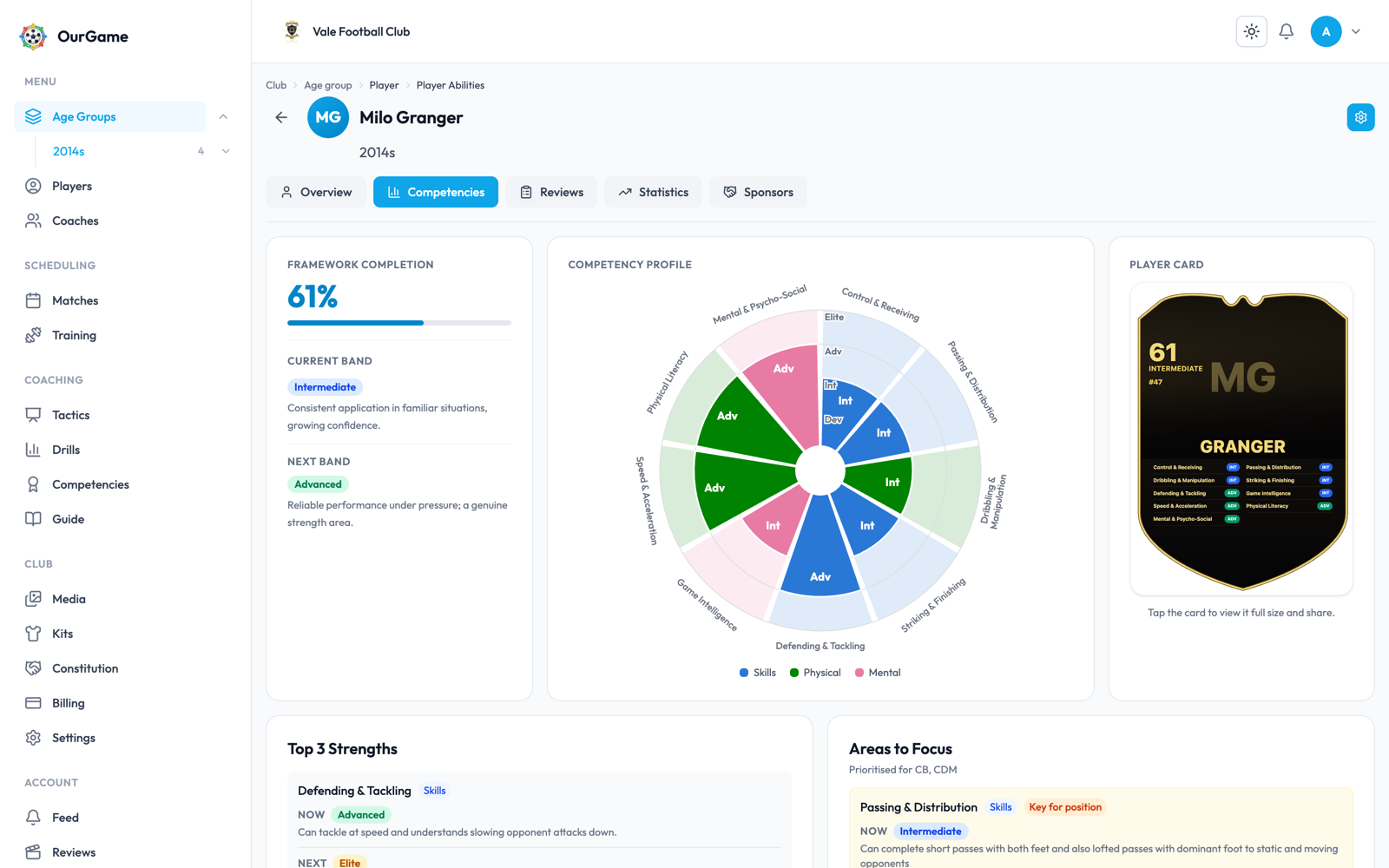
Nine competencies. Four bands, from Development to Elite. Weighted for the game a child is actually playing, so a seven-year-old at 5v5 and a fourteen-year-old at 11v11 are each judged on what matters at their stage — and every coach at the club judges against the same rubric.
Bands describe consistency, not talent
The rubric says how reliably a skill lands, in language a parent can read — never a number pretending to be precision.
Upper and lower within a band
Progress is visible long before somebody moves up. A child sees the next step, not a cliff.
One rating, everywhere
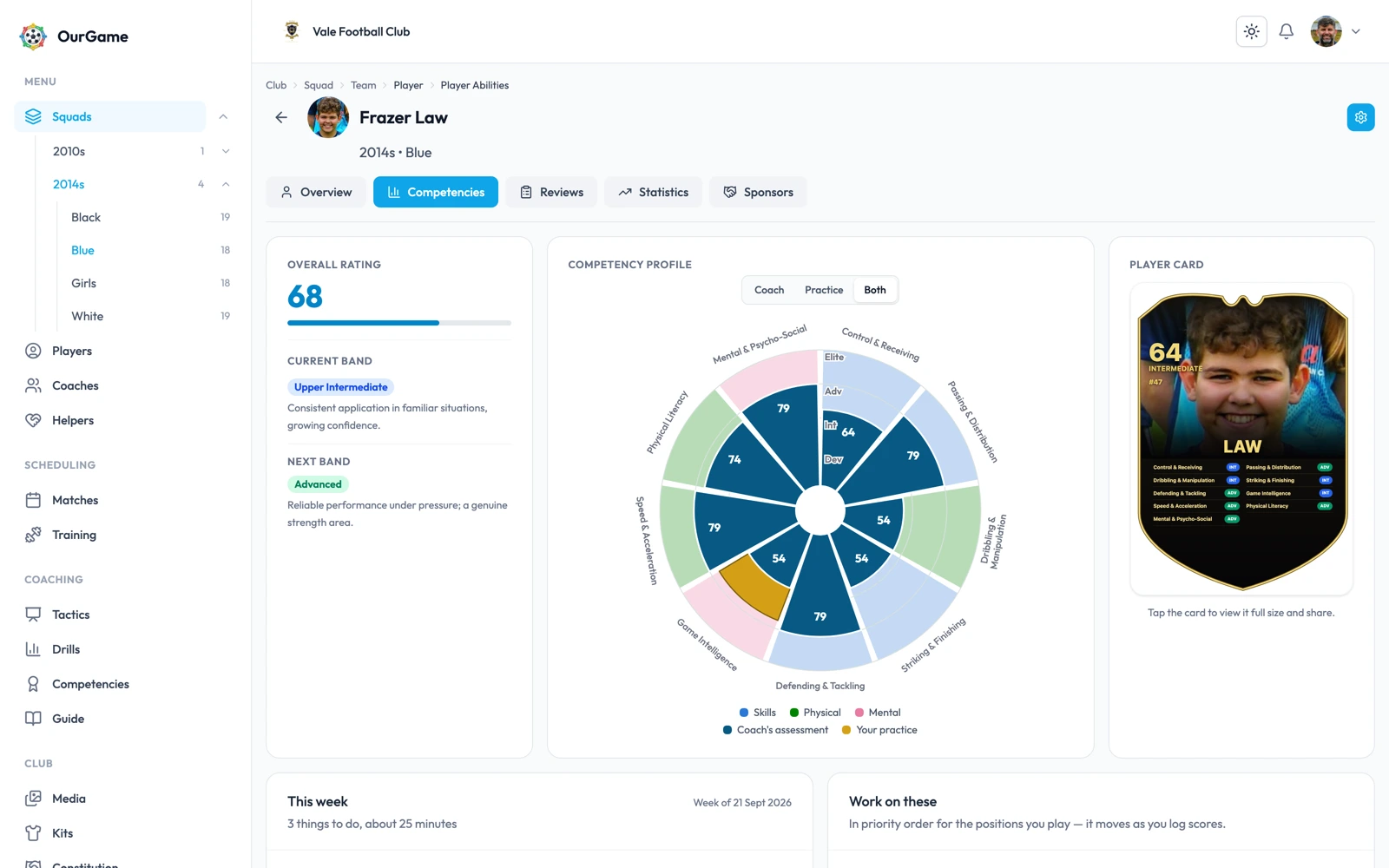
The weighted score resolves to a single 0–99 figure that is the same on the web, the phone and the player card.
A continuous picture
Assessed by one coach at eight and another at eleven, the child has one story — not two opinions that never met.
Your framework, or ours
The seeded frameworks are read-only templates — the starting point, not the rule. Clone one, rewrite the rubric and the weightings to match how your club coaches, and every player is rescored against it. The knowledge that used to live in one coach's head becomes the club's, in writing.
Development you can act on
Not just where they are. What to do about it.
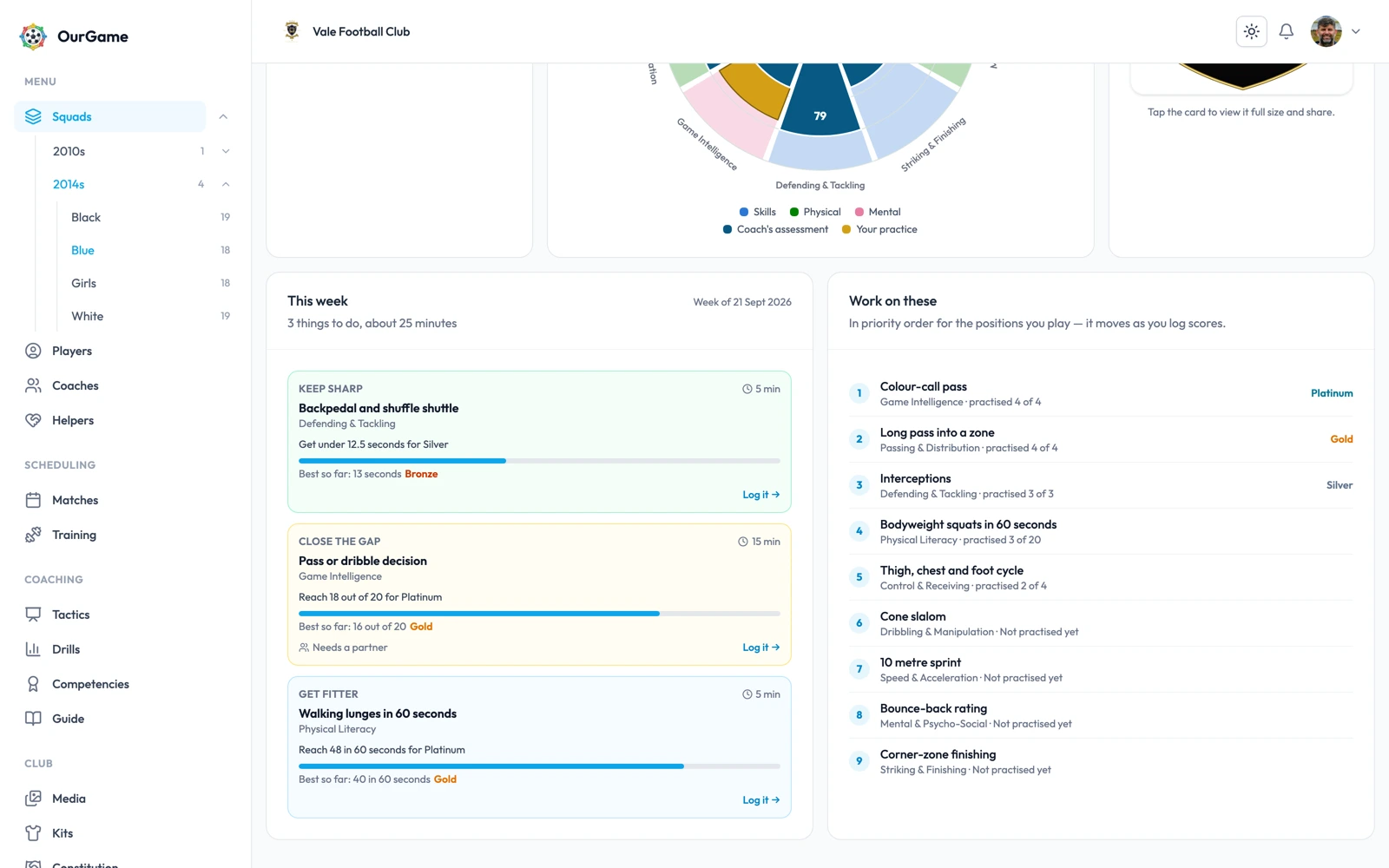
An assessment tells a child where they stand. The roadmap tells them what to do on Tuesday. Three named things a week, chosen for their positions and their gaps, about twenty-five minutes in total — and it rebuilds itself every Monday from what actually happened.
Keep sharp
The medal a player is closest to on a challenge they already know — the quick win that keeps the week moving.
Close the gap
The competency the positions they play most need, picked from their own assessment rather than a generic list.
Get fitter
A fitness challenge sized for their age. Goalkeepers included, rather than handed the outfield list and left to it.
“What should they practise?”
Every parent has asked it. Every coach has answered “just get touches on the ball”. Now the answer is specific, weekly, and theirs — and because a player logs a score and a coach verifies it, everyone can see the practice happening. Nothing a player logs can move the band a coach set. That's what keeps the band worth something.
Buy-in
A team becomes a community when everyone can see the growth
Development only sticks when the player, the parent and the coach are looking at the same picture — and looking at it for years, not a season. That shared picture is what turns a Saturday-morning team into something people belong to.
A parent's first screen
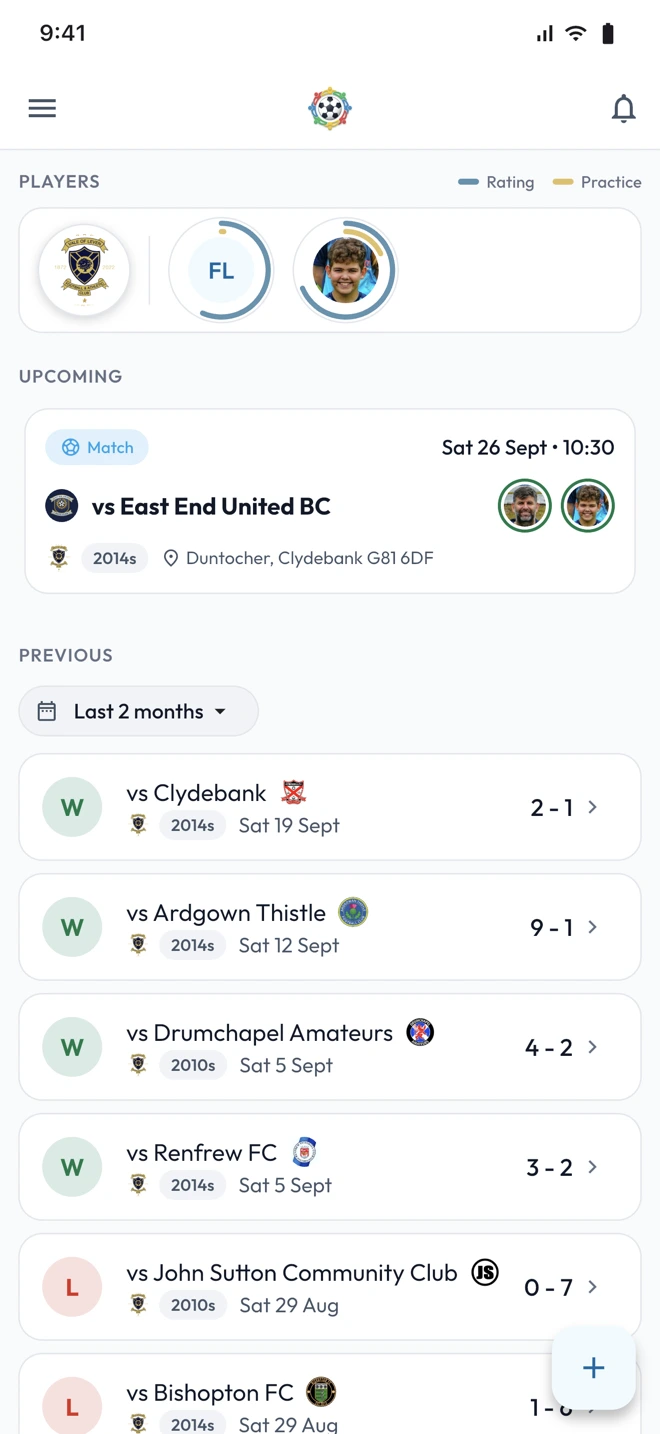
Each child's rating and practice drawn as rings, before a single fixture.
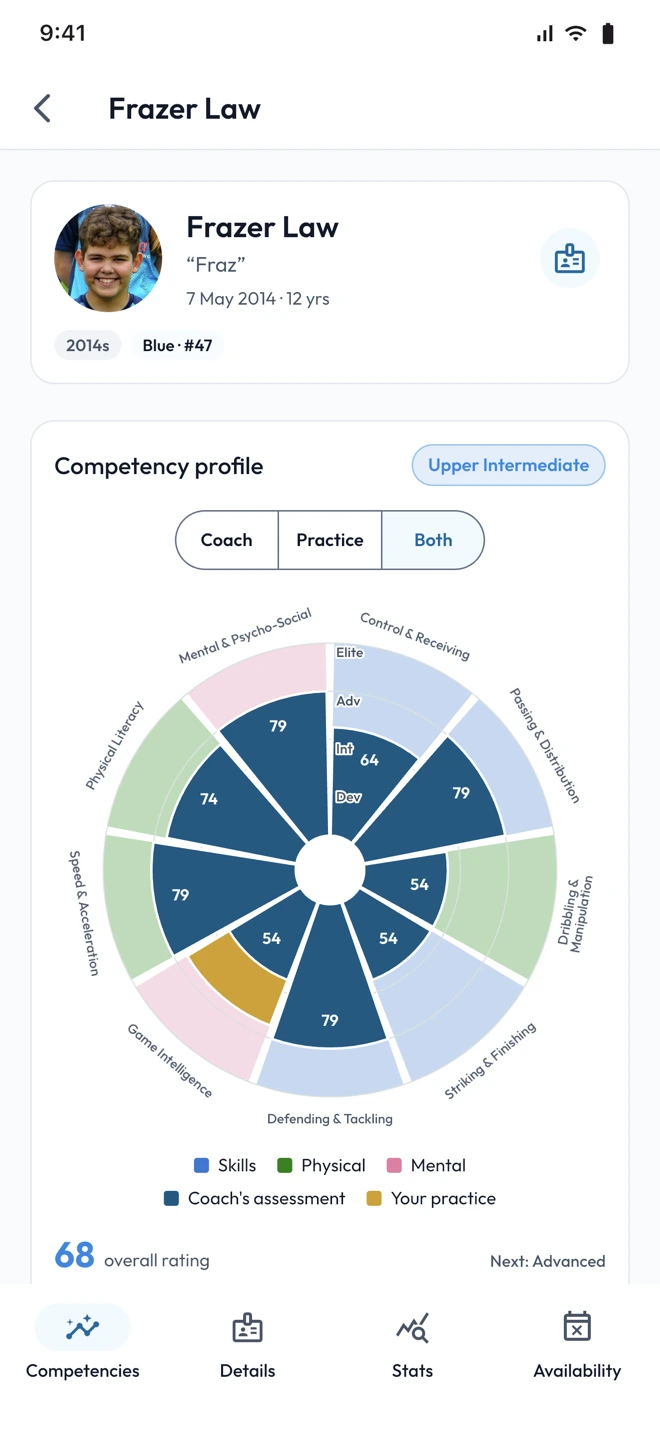
The same wheel the coach uses
The band, the next band, and practice drawn beside the assessment.
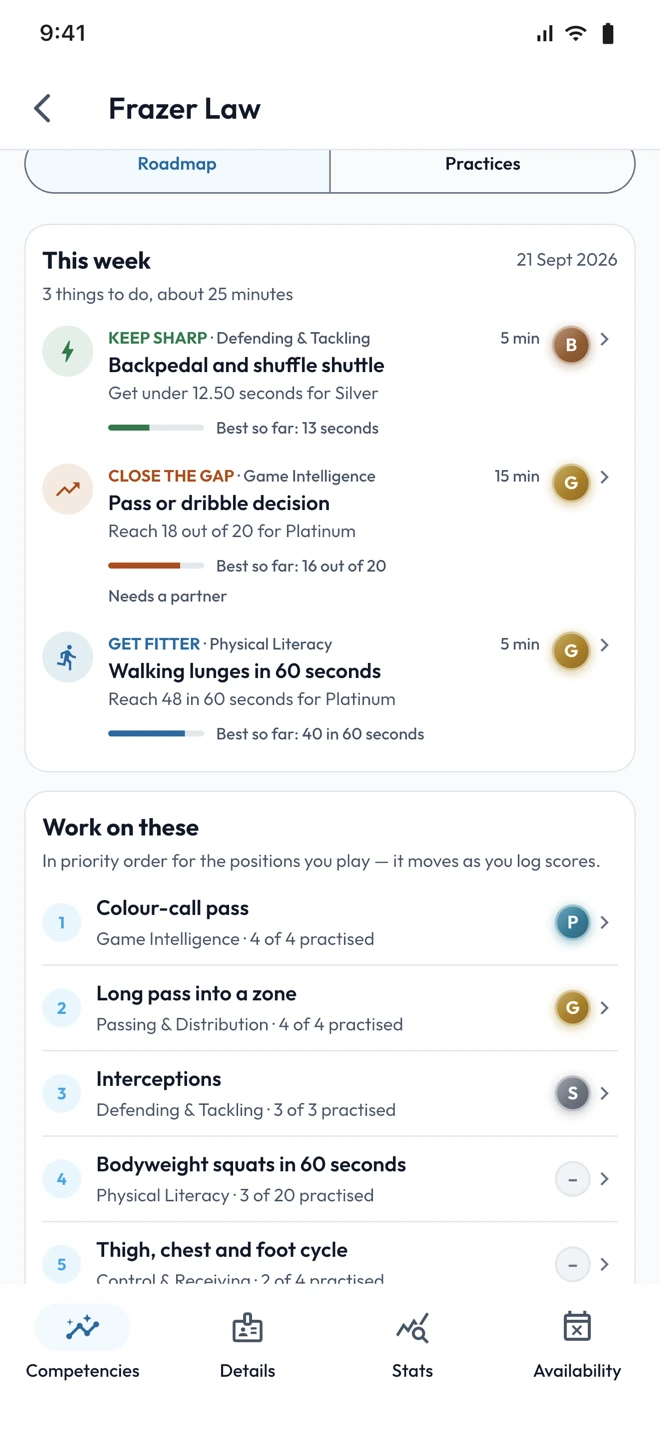
This week, in their pocket
The plan travels with the player. A parent can see it; a child can own it.
Measurable
Bands, ratings, medals, streaks. Not because numbers are the point — because a child who can see the line move keeps pushing it.
Sustained
The record follows the player across seasons, age groups and coaches. At sixteen they can look back at eight and see the road.
Shared
The player card is theirs to show. The leaderboard is the squad's. Parents stop asking how they're doing, because they already know.
When a parent can see their child getting better, they stop being a taxi service and start being a supporter.
The evolution
The coaching grows with the player
For years it should be the first touch, the practice and the confidence — and nothing more complicated than that. Only around thirteen does it become where to stand and why, and later still, reading a rotation before it happens. The tools have to grow with them, or the child outgrows the club.
Foundations
Competencies, practice, the roadmap. Touches, confidence, the basics done properly — for years, not weeks. Nothing tactical yet.
Shape and roles
Formations per format, positions on a real pitch, and the first tactical principles — in possession and out of it.
Tactics and video
Rotations that animate on the pitch, and footage review — watching themselves, with a coach's time-marked notes.
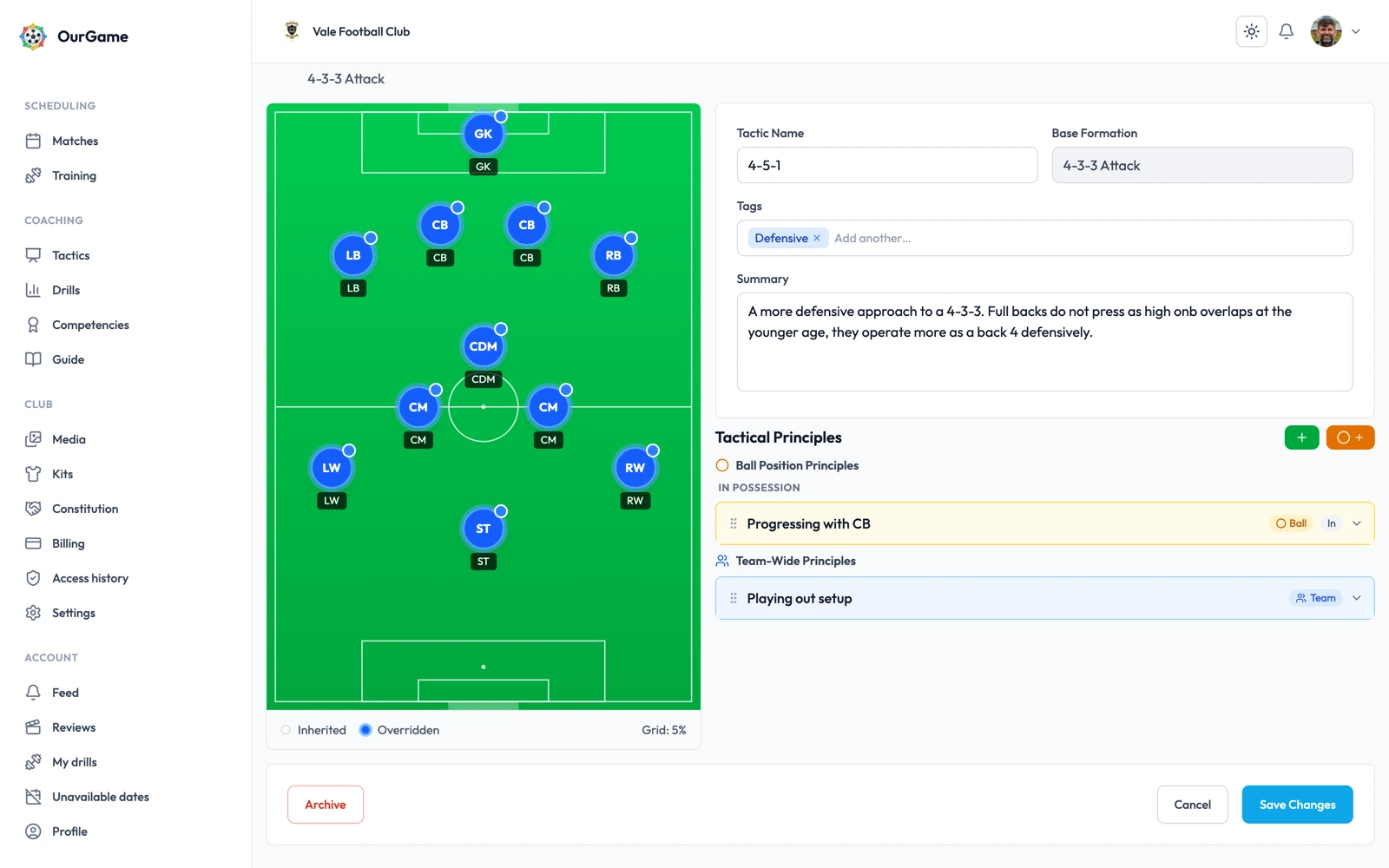
Formations, principles, rotations
The shapes that belong to 5v5, 7v7, 9v9 and 11v11 — not one set squeezed to fit. Tactical principles that name the positions they apply to and the movement they ask for: a library of how your team plays.
And rotations — two to six positions tied into a group that circulates as a unit, drawn as a loop whose dashes march in the direction of travel while the discs move. A sixteen-year-old reads the idea off the pitch without a lecture. On the phone too, in landscape, the way a coach draws it.
Watching themselves
Feedback a player can actually watch
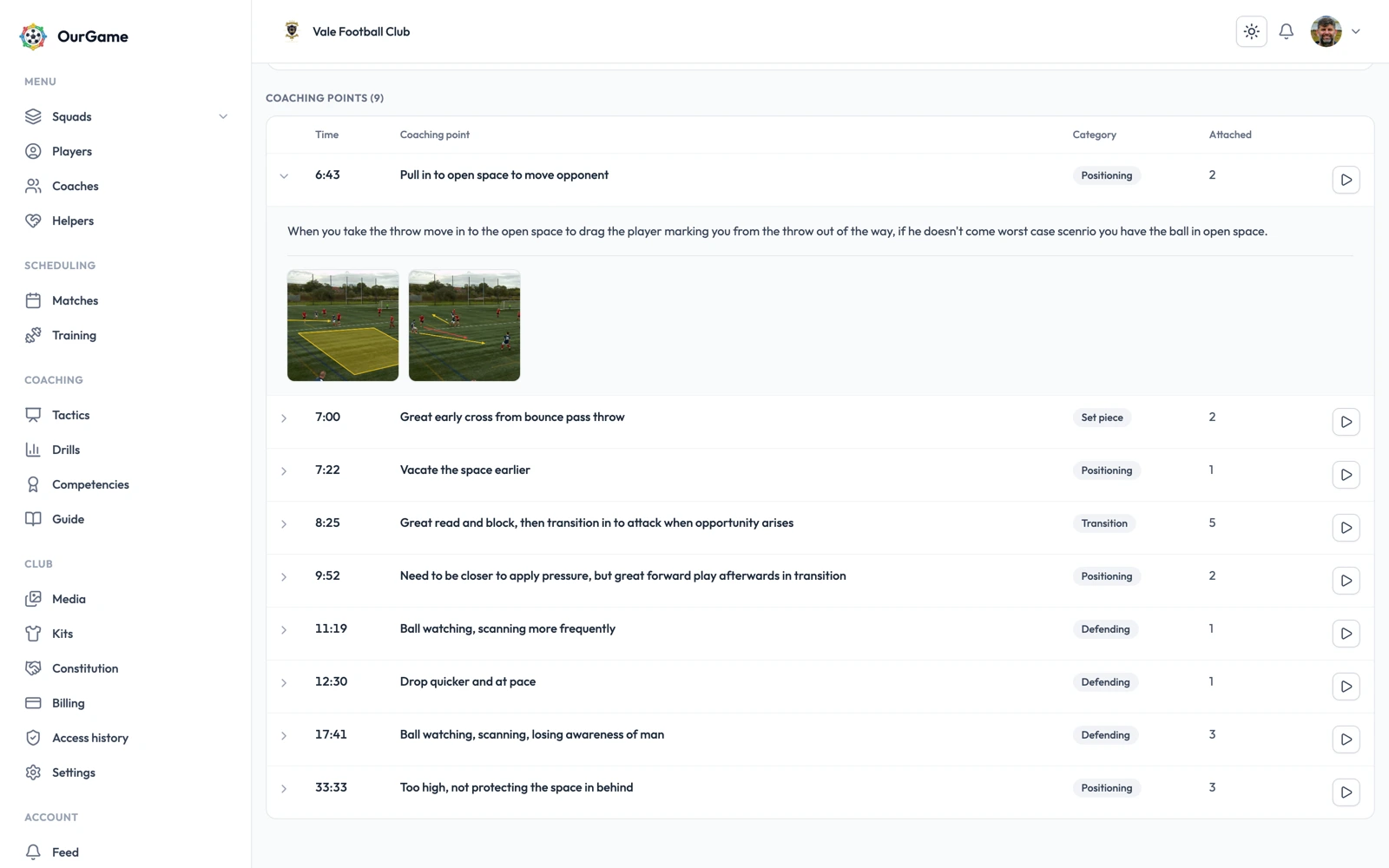
Older players learn most from seeing themselves. Academies have known that for decades. OurGame brings it to grassroots: a coach reviews a game's footage and leaves time-marked coaching points — a moment, a note, an annotated still — that a player can open on the bus home.
- Request it, get it, rate it. A parent or coach commissions a review of a game's Veo footage. A reviewing coach delivers it when ready and releases it once the requester has seen it. Both sides rate each other.
- A parent can commission one for their own child — focused on that player, and nothing else.
- Positioning, transition, defending, set pieces. Every point is categorised, so a season of reviews reads as a pattern rather than a pile of notes.
The academy tool, at the grassroots price
Video analysis used to mean a full-time analyst and a budget. Here it means a coach with an evening, a Veo link and a phone — and a sixteen-year-old who finally understands what “drop quicker” looked like from the outside.
For the coach
Build the session, not the spreadsheet
A coach's evening should go on what the under-10s need next week, not on remembering what the cone layout was. Drills, diagrams, session plans and feedback in one place — and a library that stays with the club when the coach moves on.
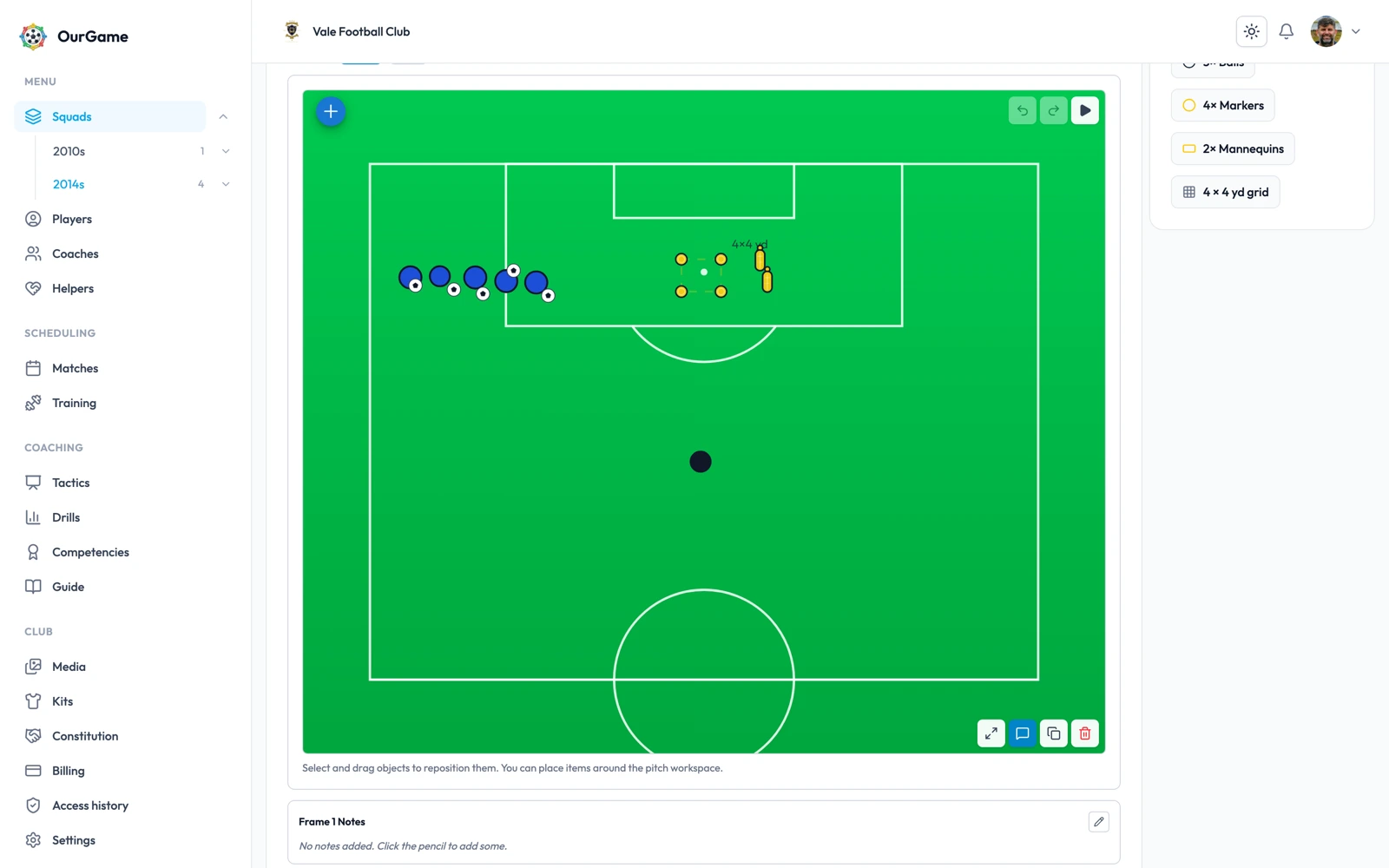
Drills that move
Built as keyframes, so players and the ball glide between steps — any coach can pick one up and run it. Build one from a video clip or a photo of a whiteboard. A drill belongs to a person, not a club, so a coach keeps their library when they move age group — and shares a whole collection with the next coach in one go.
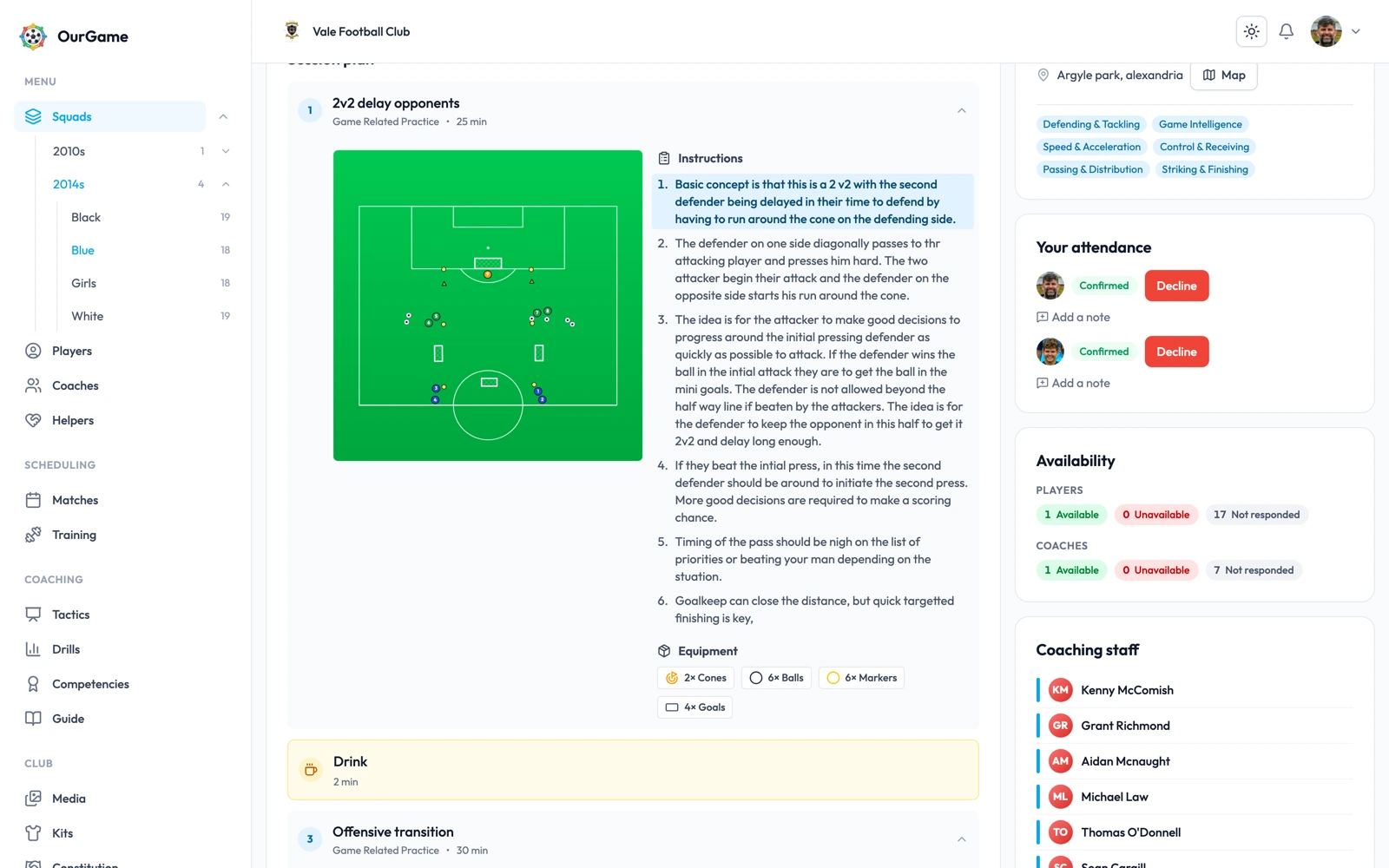
The loop closes
A session names its focus areas; the roadmap shows each player what the club is working on; the assessment records whether it landed. Attendance sits beside the match RSVPs. And the session a Tuesday coach ran is there for the Thursday coach to see — a team of coaches, one library.
The bonus
Everything else — so you can coach
None of this is the point. It's what makes the point possible. The admin takes minutes, so the coaching takes the evening.
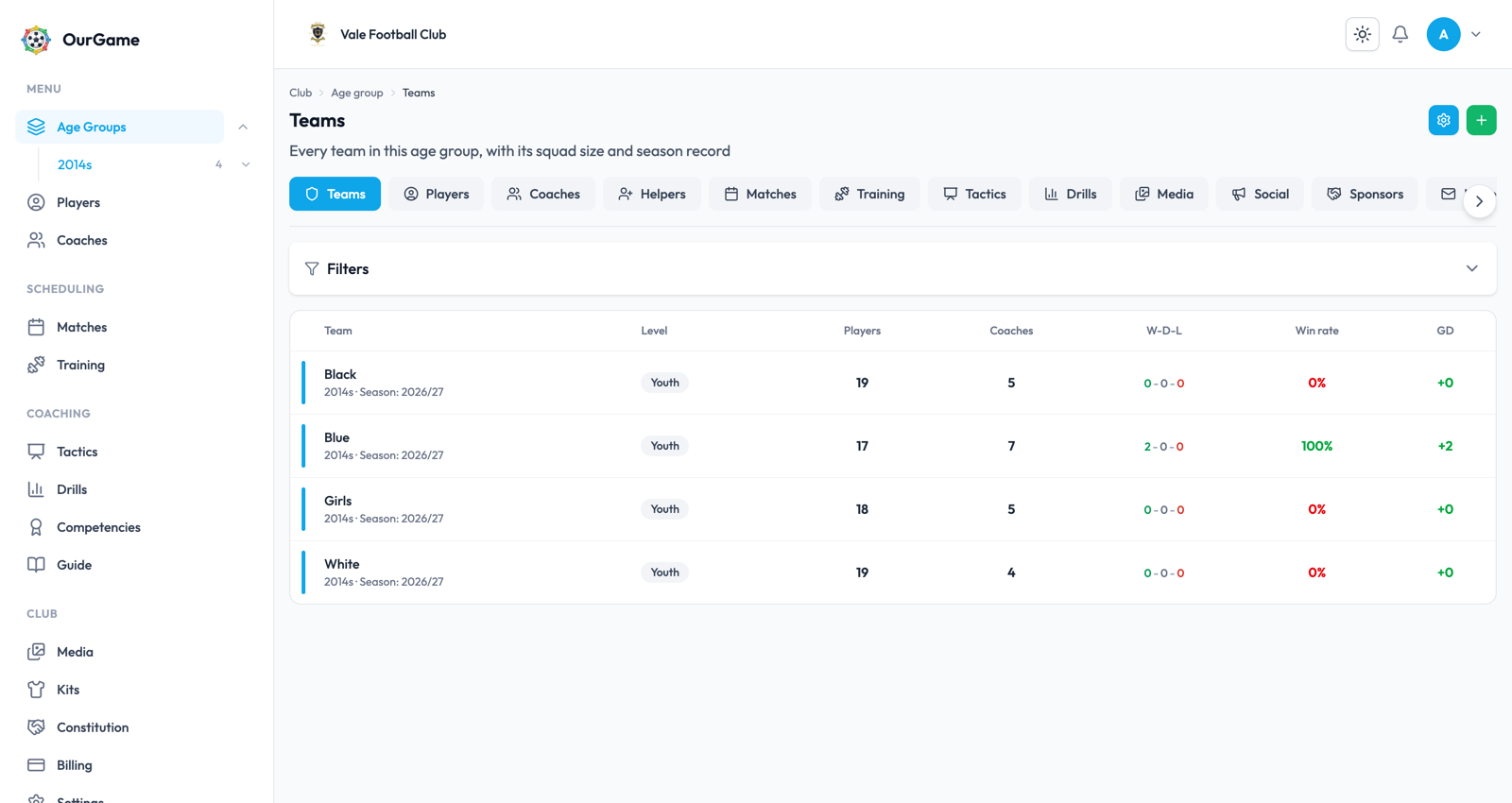
The whole club at a glance
Every squad and team, its people, its season — so a volunteer can see how the club is actually made up without digging through five different chats.
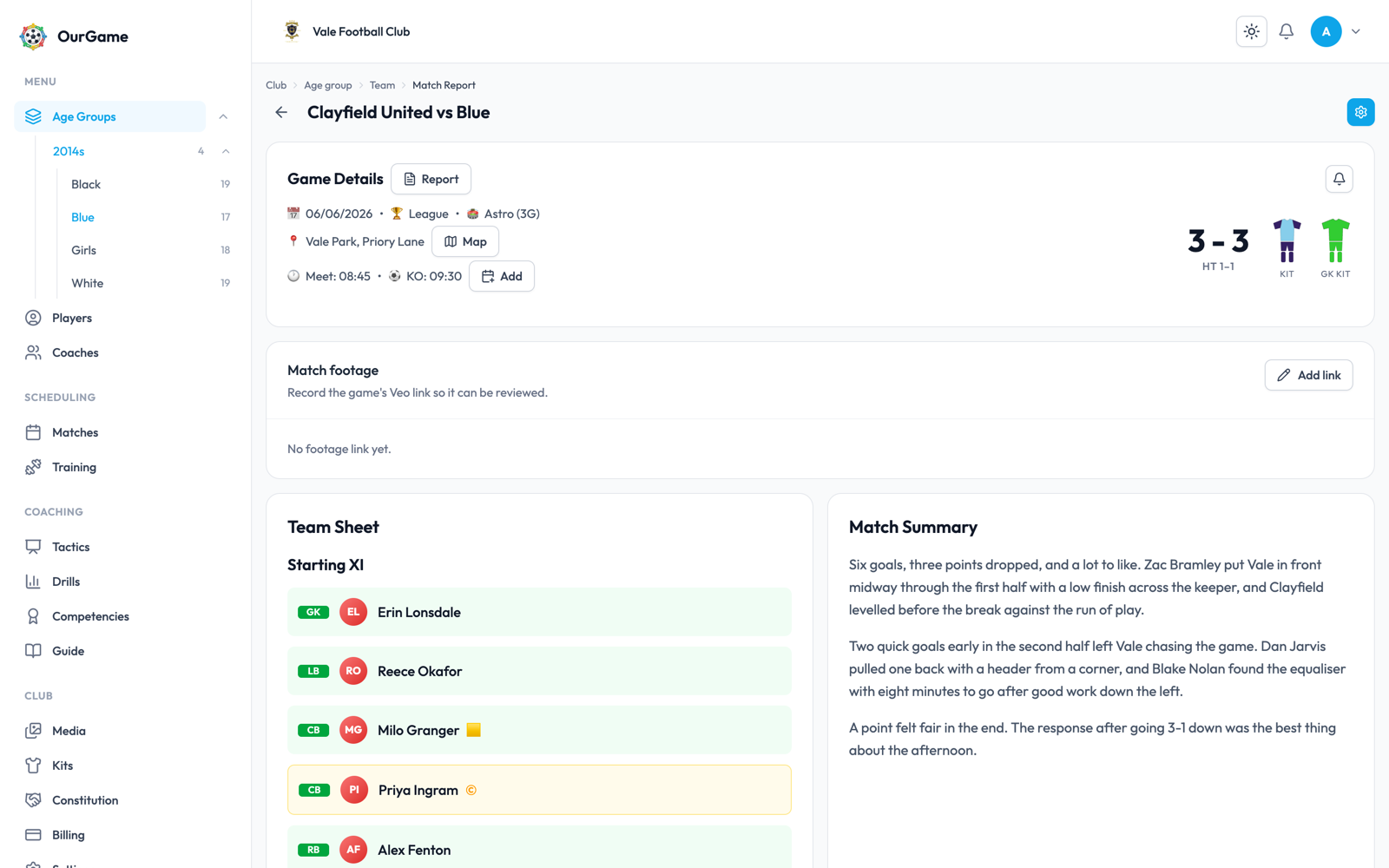
Call the game as it happens
Goals and cards as they go in. The score updates instantly and parents get a push notification — no more 'what was the score?' texts after the final whistle.
- Live match day — goals, cards and subs as they happen, pushed to every parent
- Fixtures and results for every team, with kits, venues and RSVPs in a tap
- "Away in July" — declared once, marked on every fixture it touches
- A published match report with sponsors, and social graphics ready to post
- The supporters' player of the match, voted on the team sheet
- Four languages, per person — English, Welsh, Spanish and Portuguese
- Fifty-three permissions bundled into roles, granted per club, squad or team
- Bulk import by CSV, invite links, and an access history of who gave what
Every screen, both clients, both themes
135 screens of the real app — including the unglamorous ones.
What it could mean
A generation developed on purpose
None of this needs a bigger budget, a new coach or a better pitch. It needs the knowledge that already exists to be written down, shared, and put in front of the right people every week.
For a player
They leave every season better than they arrived, and they can see it. Not "played a lot", not "had a good year" — a band, a rating, a medal, and a plan for next week.
For a club
The knowledge stays. When a coach moves on, the framework, the drill library and every player's history don't go with them. The next volunteer inherits a club, not a blank page.
For the game
If every grassroots club developed players with intent, the next generation wouldn't depend on who happened to turn up on a Tuesday. That's not a slogan. It's structure, given to the people who never had it.
The game got complicated. Getting better at it doesn't have to.
We built OurGame at a real club, for the volunteers who run it — because we watched good coaches drown in admin while the children they coached got better by chance. Put one squad on it and see what a season looks like when development is the point.
Interested? Get in touch.
We're setting clubs up by hand for now — no form, just a conversation. Tell us a little about your club and we'll get you started.
A line or two is enough: the age groups you run, how many teams at each, and who coaches them. We'll help you shape the squads, import the players and get the first fixtures in.
1. Email us
Tell us how the club is shaped. No form to fill in.
2. We set it up together
Squads, teams, players and the first fixtures — with you, not for you.
3. The season starts
Every coaching feature from day one: the framework, the plans, the drills, the phone app.
Before you ask
Do we need to be an academy to use the framework?
No. It was built for volunteer clubs. The seeded frameworks work out of the box — nine competencies, four bands, weighted for the format your children play. Clone and rewrite one if your club coaches differently, and every player is rescored against it.
Can a player's practice change their band?
No — only a coach can set a band. Practice is drawn beside the assessment on the same scale so everyone can see the effort, but the judgement stays a coach's. That's what keeps the band worth something.
What do parents and players need?
An invite link and the phone app. They see fixtures, their child's development picture, this week's plan, and a vote for player of the match. Coaches and admins run the club from the web.
What is a footage review?
A coach reviews a game's Veo footage and delivers time-marked coaching points with annotated stills. The platform brokers the request, the delivery and the release. A parent can commission one for their own child.
Which languages do you support?
English, Welsh, Spanish and Portuguese, across the web app, the phone app and every notification — chosen per person, not per club, so a Welsh-speaking parent and an English-speaking coach read the same fixture in their own.
Is our data safe?
Medical and contact details are stored securely and access is permission-based — fifty-three permissions granted at club, squad or team level, so a coach only ever sees the teams they work with. We never run ads against children's data.
Can we bring our existing squad in?
Yes — import players by CSV in one go, and export rosters back out for your league whenever you need them.
Put one squad on it. See the season.
Get in touch and we'll set your club up. We'll help you shape the age groups, import the players and get the first fixtures in.